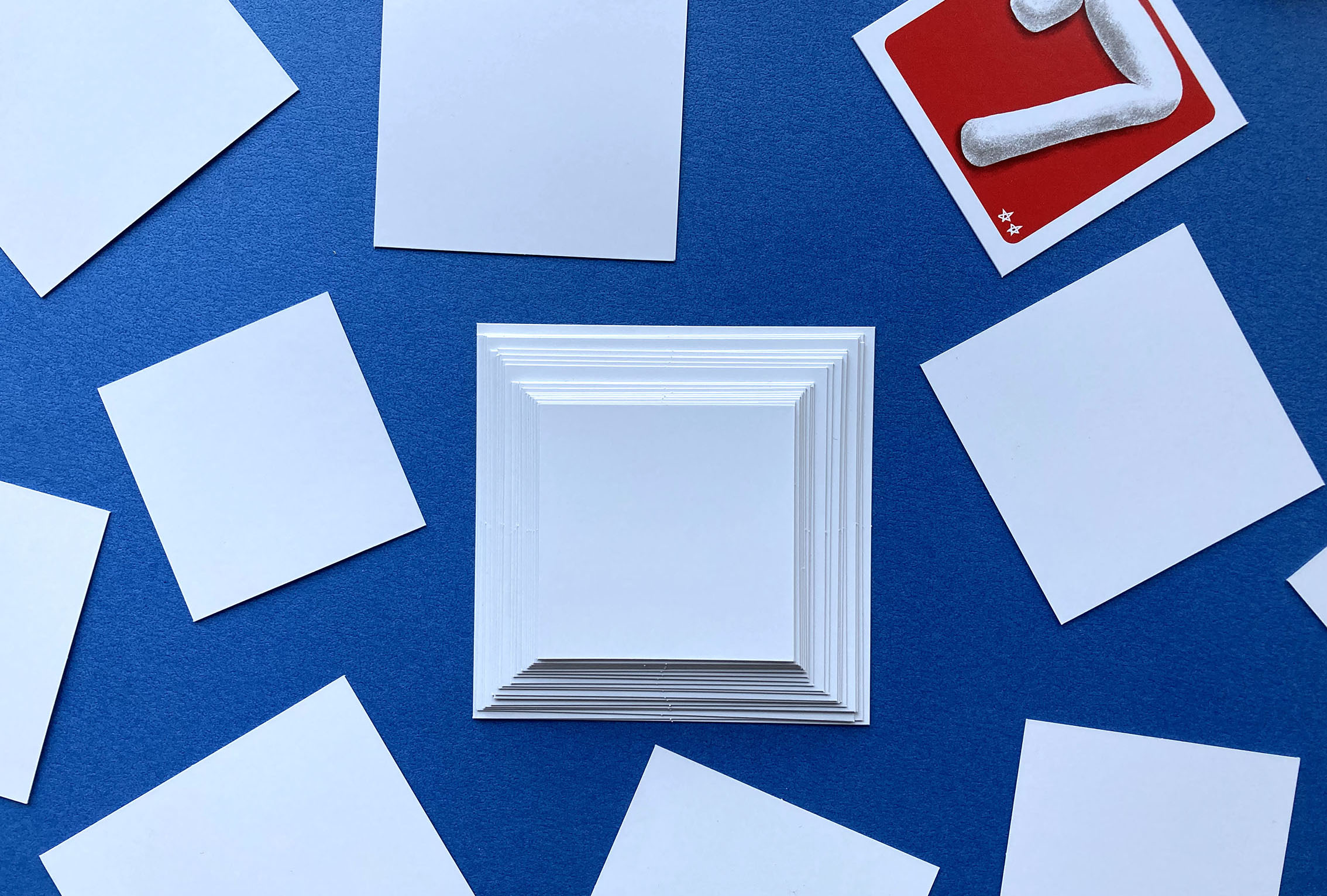
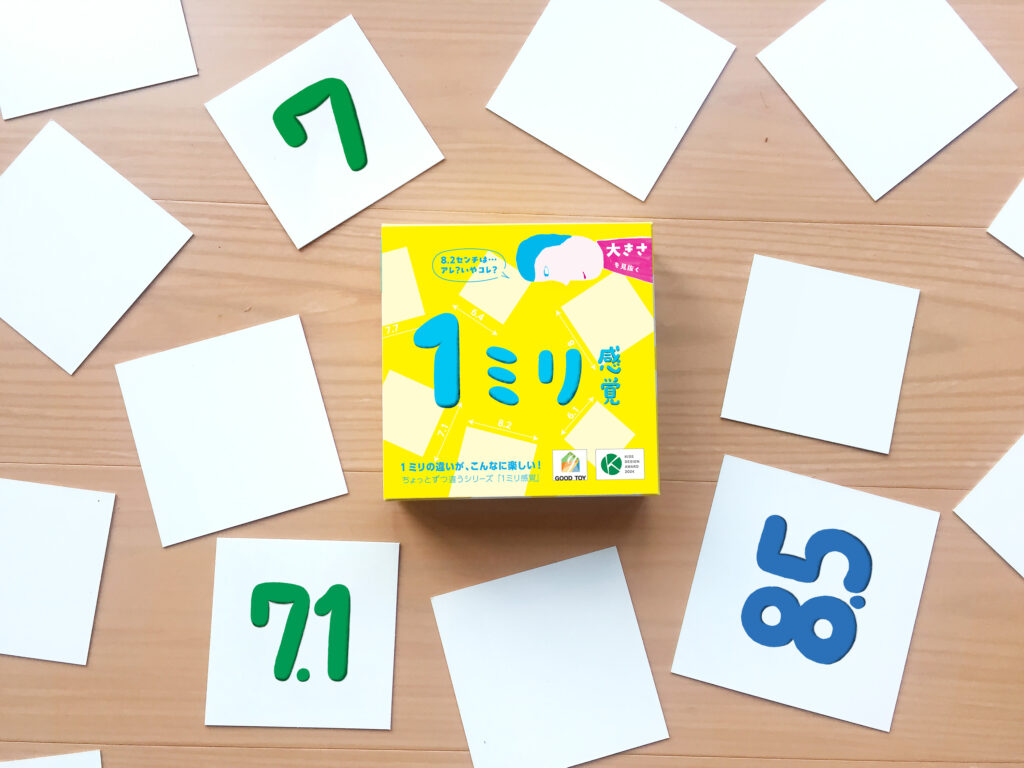
This is a game where you try to guess which square (card) is off by just 1 millimeter, relying on your intuition.
It captivates everyone—from children to adults, and even professionals who work with spatial concepts and measurements.
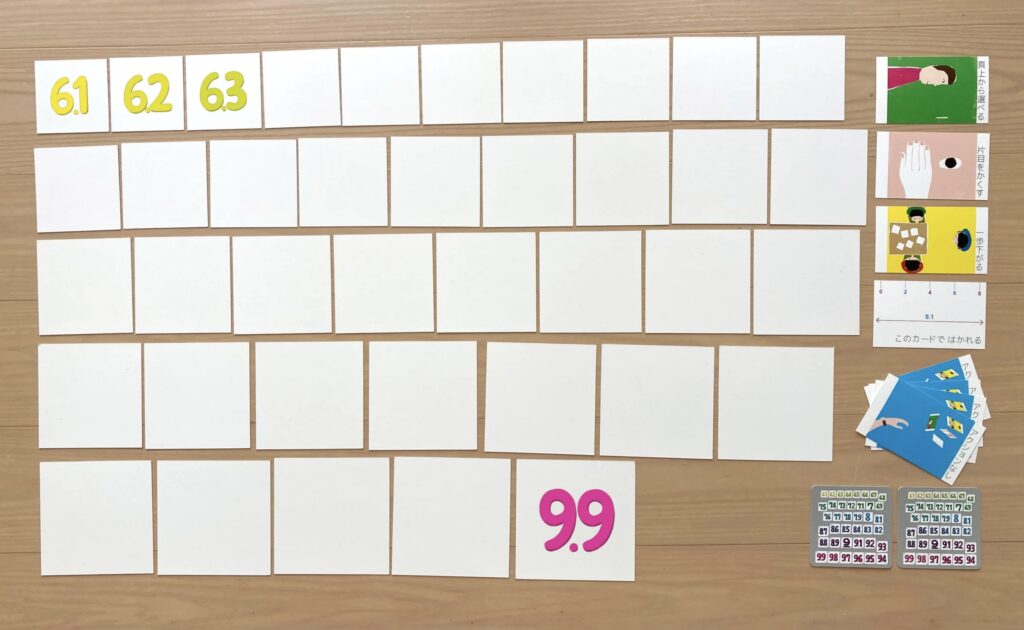


Action Card
This can work to your advantage or disadvantage, adding an extra twist to choosing the right size. If you just want to play simply, feel free to play without using it.
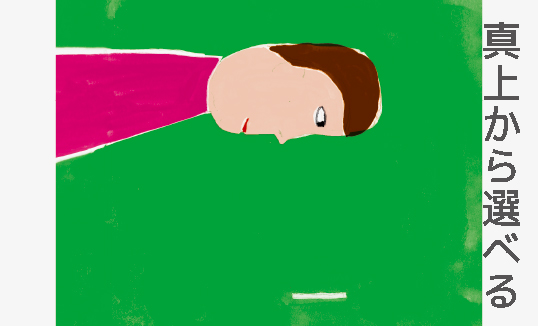
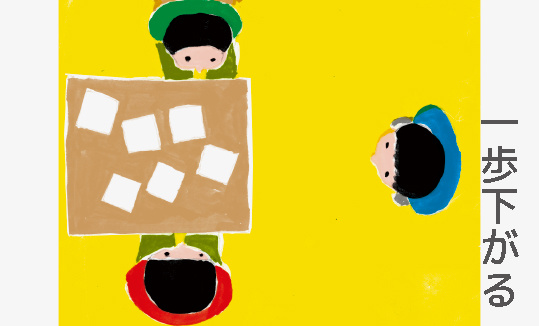


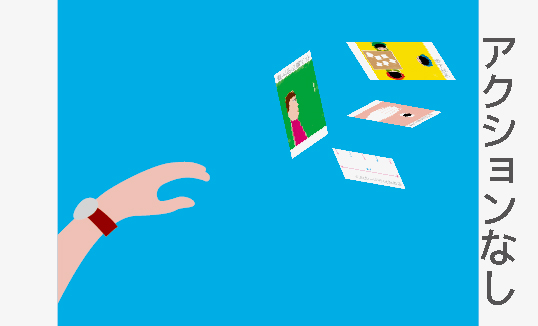
Basic Gameplay
Players use their sense of scale to guess whether the card flipped over by a parent is off by 1 millimeter. If they correctly guess a 1-millimeter difference, they get 2 points; if they guess a 2-millimeter difference, they get 1 point. Players compete for the highest total score.
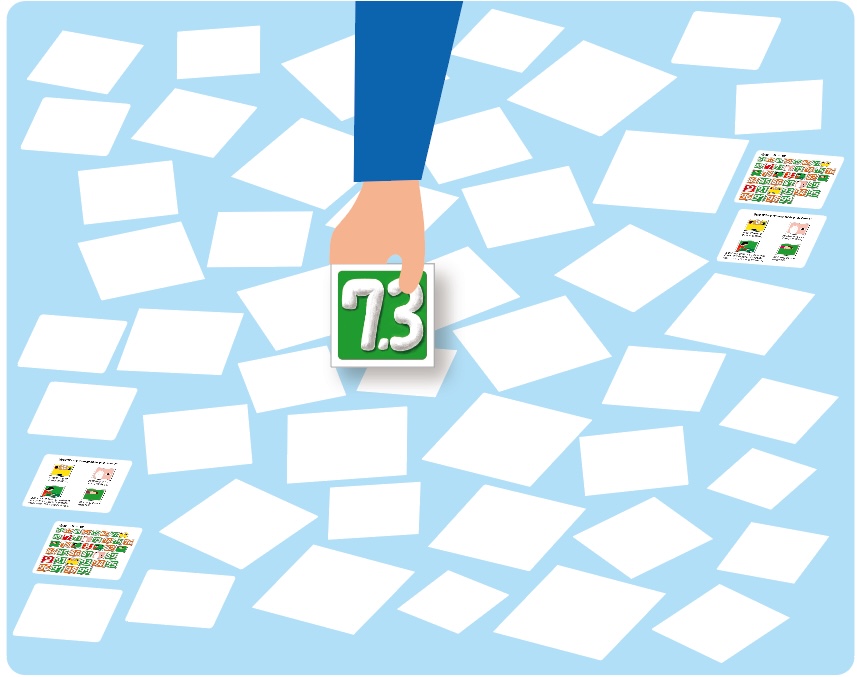
Cooperative Game “Piramirid”
Select cards in order from largest to smallest and stack them to build a pyramid. If you can build a pyramid with 20 or more cards, you’ve succeeded.
Sight and Touch
Like Indian Poker, you play by placing a card on your forehead. You guess the size of your card by feel. The person whose card is closest to the number called by the dealer scores points.
Preparation: Shuffle all the number cards thoroughly, then place them face down to form a deck. Place a handkerchief or similar item on top of the deck to cover it. Place the reference card on the table and decide who will be the first dealer. [Example: Player A is the first dealer.]
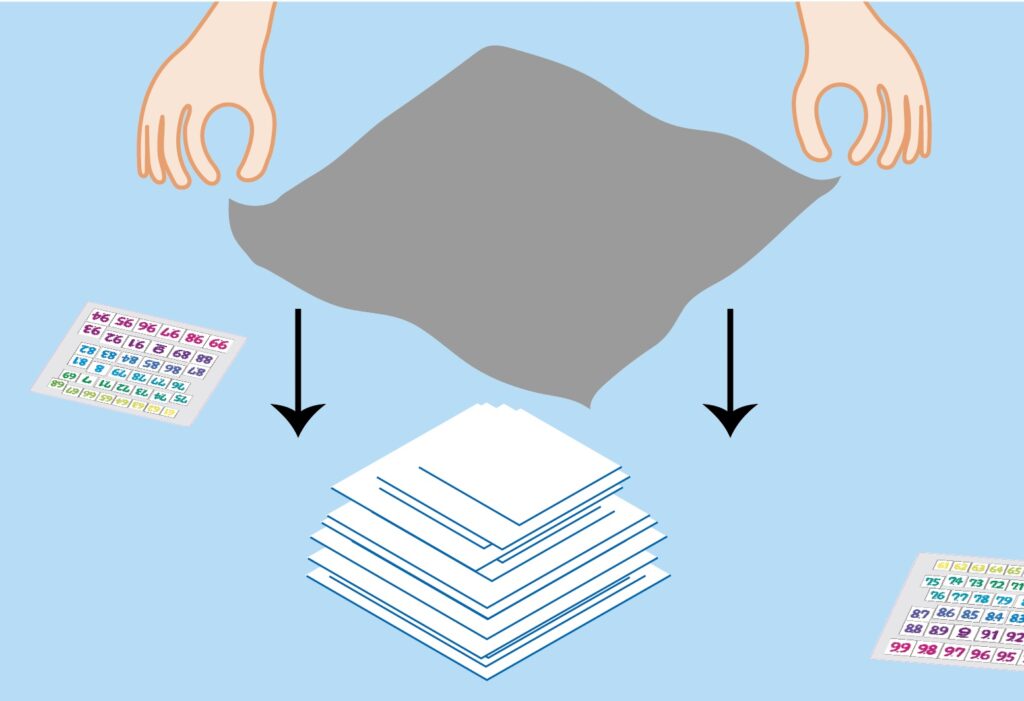
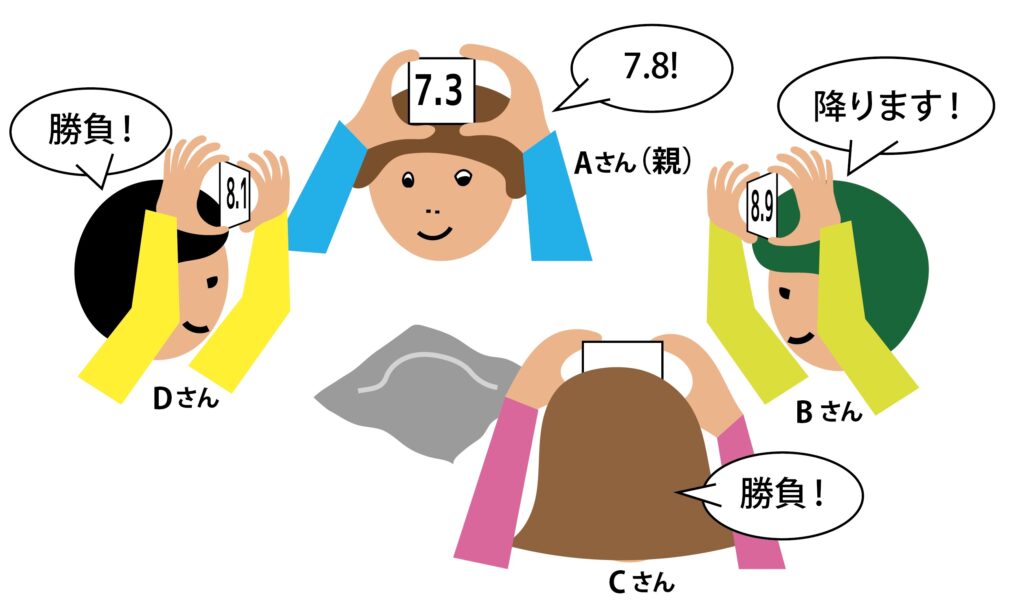
How to Play ① From the deck under the blindfold, each player draws one card without looking at the number and holds it against their forehead. [Example: Player A has “7.3,” Player B has 8.9, Player C has 7.1, and Player D has 8.1.]
② Everyone tries to guess the value of their own card by feel. The dealer predicts the number on their card and announces it. [Example: Player A announces “7.8.”]
③ The remaining players decide whether to compete this round. Among those competing, the player whose number is closest to the dealer’s declared number scores a point. Players who wish to compete say, “Let’s go!” Players may also choose to fold and not compete. *The dealer must always compete. [Example: Player B folds, Player C says, “Let’s go!”, and Player D also says, “Let’s go!”]
④ All players reveal their card numbers. Among those who competed, the player whose number is closest to the dealer’s declared number scores a point. *If there is a tie, the dealer scores the point. The player who accepted the challenge collects all the cards from the other players who accepted and keeps them. [Example: Player D, whose number was closest to 7.8, received 3 cards (from Players A, C, and D).]
⑤ Discard the cards from the players who folded, pass the dealer role to the next player, and repeat from step ①, moving to the next dealer and then the next. The game ends when the deck runs out. Rankings are determined by the number of cards collected.
Spot the Joker by Instinct
While regular “Go Fish” is a game of chance, this version of “Go Fish” provides size clues on the backs of the cards. When selecting a card, you can use the size as a clue. The rules are almost the same as regular “Go Fish.” [Difference]: You must match the last digit of the number. If they match, discard the pair onto the table. *Action cards are not used in this game.
■Set Contents
・Game Cards…39 cards
・Reference Cards…2 cards
・Action Description Cards…2 cards
・Instruction Manual…1 copy
■Box Dimensions: 10.0 cm (H) x 10.0 cm (W) x 2.5 cm (D)